

2026 GUIDELINE: Damage Restoration SEO
Damage restoration SEO is the process of ranking your business in Google so homeowners and property managers find you first when they need water, fire, or mold cleanup. When done correctly, it generates consistent inbound calls without relying on paid ads.
Table of Contents
What Is an Average Damage Restoration Job Worth?Restoration Costs by U.S. Market
How Much Is a Damage Restoration Lead Worth?
What Is Damage Restoration SEO?
Why Most Restoration Companies Fail at SEO
How Google Ranks Restoration Companies
Keyword Strategy That Drives Calls
On-Page SEO That Converts
Google Business Profile and Map Pack Rankings
Content Strategy for Consistent Leads
Turning Traffic Into Calls and Jobs
Implementation Plan
What Is Damage Restoration SEO?
Damage restoration SEO is the process of optimizing your website and online presence so your company appears when someone searches terms like “water damage near me” or “fire damage restoration.”
Unlike paid ads, SEO compounds over time. Once you rank, you generate leads daily without paying for each click.
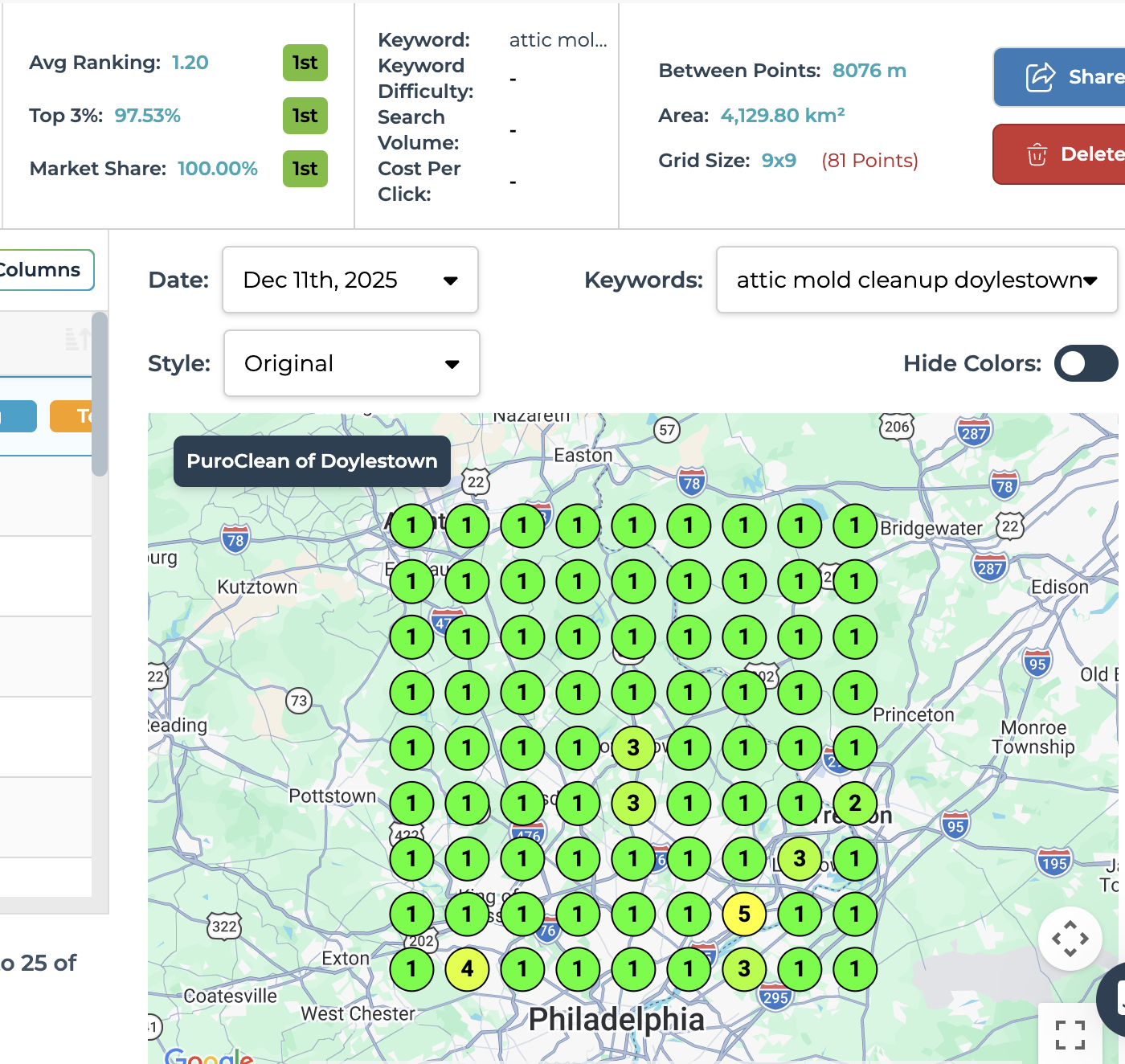
Why Most Restoration Companies Fail at SEO
Most companies fail because they treat SEO like a checklist instead of a system.
- They target the wrong keywords
- They don’t optimize for local intent
- They ignore conversion optimization
- They rely only on their homepage
The result: low rankings, low calls, and inconsistent job flow.
A proper restoration marketing strategy integrates SEO, GBP, and referral channels into one system.
How Google Ranks Restoration Companies
Google uses three primary factors:
1. Relevance
Your content must match what users are searching for.
2. Authority
Your site must show credibility through content, links, and engagement.
3. Proximity
Local businesses are ranked based on distance to the searcher.
This is why combining SEO with local SEO for restoration companies is critical.
Keyword Strategy That Drives Calls
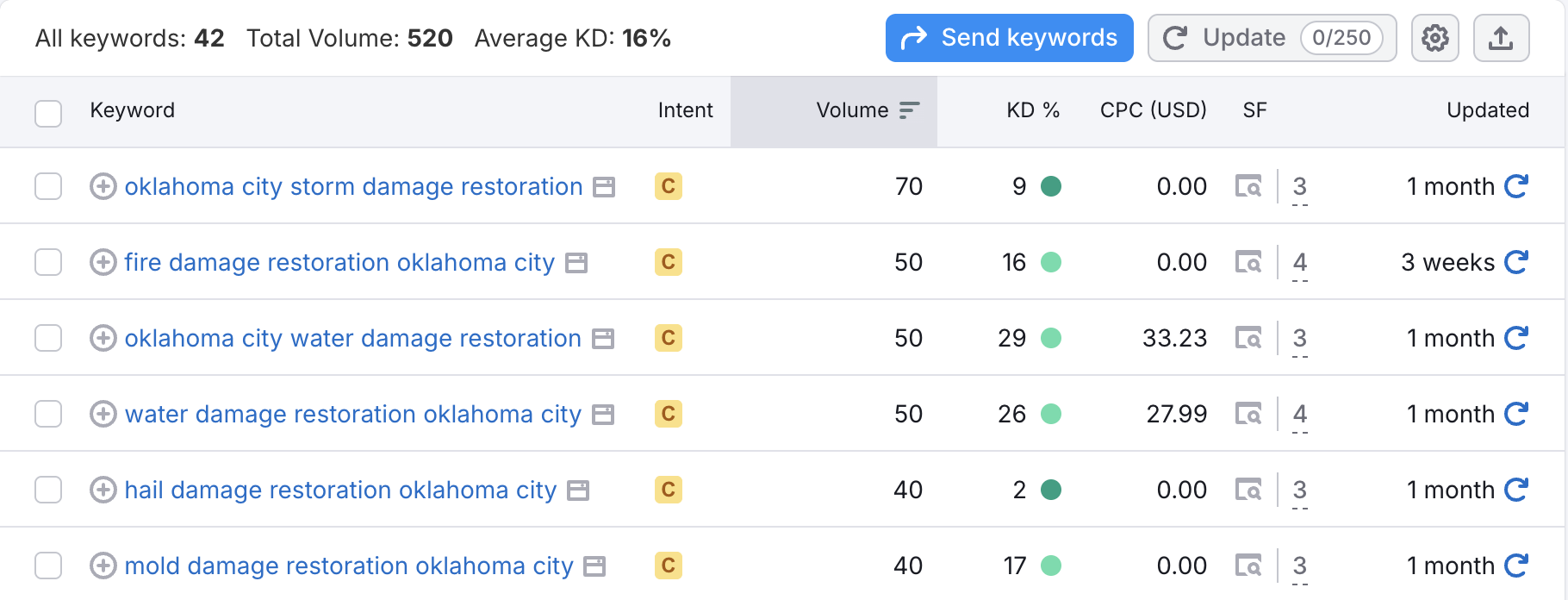
Not all keywords are equal. You need to focus on high-intent terms.
Examples:
- Water damage restoration near me
- Emergency water cleanup
- Fire damage repair company
These keywords signal urgency and lead directly to calls.
Supporting content like water damage restoration SEO pages helps capture additional traffic and funnel it to your main services.
On-Page SEO That Converts
Ranking is only half the battle. Your page must convert.
Key elements:
- Clear H1 with keyword
- Strong opening paragraph
- Internal linking structure
- Call-to-action above the fold
Need Help Now?
What Is an Average Damage Restoration Job Worth?
Damage restoration and specialty-cleanup leads are valuable because a single qualified call can turn into a project worth thousands—or, in severe cases, tens of thousands—of dollars. The actual project value depends on the service, property type, severity of the loss, affected square footage, contamination level, structural damage, disposal requirements, and whether reconstruction is needed.
Consumer pricing data available in 2026 provides useful benchmarks for understanding what restoration and cleanup companies may bill for common residential projects.
| Restoration Service | Typical / Average Project Value | Common Range | Why It Matters for Lead Value |
|---|---|---|---|
| Water Damage Restoration | About $3,867 nationally | Approximately $1,383–$6,371 for many residential projects | Even an ordinary water-loss lead can represent several thousand dollars in project revenue, with larger or contaminated losses worth considerably more. |
| Fire & Smoke Restoration | About $27,477 nationally | Approximately $3,000–$52,000 for many projects, with major structural losses running much higher | A single qualified fire-loss lead can be worth many times more than a typical residential water-damage lead. |
| Mold Remediation | About $2,368 nationally | Approximately $1,223–$3,757 for many projects | Mold projects may be smaller than major fire losses, but qualified leads can still produce meaningful revenue and uncover related moisture or water-damage work. |
| Hoarding & Biohazard Cleanup | Approximately $1,000–$4,000 for many residential cleanups | About $1–$2 per square foot, with severe, whole-home or biohazard-contaminated projects costing substantially more | Hoarding leads can involve labor-intensive sorting, debris removal, sanitation, odor treatment and biohazard remediation—creating multiple revenue opportunities from one qualified inquiry. |
These figures are national consumer benchmarks, not guaranteed project values. Local labor rates, property size, insurance coverage, contamination, accessibility and the scope of reconstruction can substantially affect the final invoice. For example, HomeGuide estimates that many professional hoarding cleanups cost between $1,000 and $4,000, while severe conditions involving biological hazards, pests, mold or extensive disposal may cost considerably more.
These figures are consumer pricing benchmarks, not guaranteed contractor revenue. Insurance pricing, local labor rates, emergency-service charges, demolition, contents work, reconstruction, equipment usage, and project scope can materially change the final invoice.
How Restoration Project Costs Vary by Market
Geography also matters. Labor costs, housing stock, property values, local building costs, and the typical severity of losses can make the same restoration service worth substantially more in one market than another.
| Market | Service | Average / Reported Cost | Reported Range / Unit Cost |
|---|---|---|---|
| United States | Water Damage Restoration | About $3,867 | About $1,383–$6,371 |
| Los Angeles, CA | Water Damage Restoration | About $3,728 | About $1,567–$5,960 |
| Raleigh, NC | Water Damage Restoration | About $8,407 | About $1,935–$14,880; roughly $6.55–$16.38 per sq. ft. |
| Boston, MA | Water Damage Restoration | Varies by scope | About $2.45–$6.13 per sq. ft. |
| Los Angeles, CA | Fire Damage Restoration | About $6,720 | About $2,866–$12,500 in Angi’s local dataset |
| Washington, DC | Fire Damage Restoration | About $29,366 | Varies substantially by severity and structural damage |
| Philadelphia, PA | Mold Remediation | About $2,438 | About $1,298–$3,661 |
| New York, NY | Mold Remediation | About $2,541 | About $1,314–$3,783 for many partial remediations |
The table illustrates an important point for restoration marketing: there is no universal value for a restoration lead. A lead in a higher-cost market, a commercial market, or a service category such as fire restoration may be economically worth far more than a smaller mold or water loss.
Residential vs. Commercial and Property-Manager Restoration Jobs
Residential losses provide the clearest published pricing benchmarks, but commercial and multifamily restoration projects can produce materially larger invoices because a single incident may affect multiple units, common areas, tenants, inventory, equipment, or ongoing business operations.
| Customer Type | Typical Economic Profile | Potential Marketing Value |
|---|---|---|
| Residential Homeowner | Usually one property and one loss; common water projects often land in the low-to-mid thousands. | High-intent emergency leads can still justify substantial acquisition cost because conversion can happen quickly. |
| Commercial Property | Larger square footage, more expensive contents, operational disruption, and more complex drying or reconstruction can create five-figure or larger losses. | A single qualified commercial opportunity may justify a much higher acquisition cost than an ordinary residential lead. |
| Property Manager / Multifamily | One relationship may control dozens, hundreds, or thousands of units and generate multiple restoration events over time. | The lifetime value of the relationship can be substantially higher than the value of the initial loss. |
Published national pricing data is not standardized enough to responsibly state one average commercial or property-management invoice, so marketers should avoid applying a fabricated industry-wide number to those accounts. The more useful metric is the expected value of the opportunity based on property type, loss severity, close rate, gross margin, and repeat-business potential.
How Much Can a Restoration Company Afford to Pay for a Lead?
Job value is what makes damage restoration lead generation fundamentally different from low-ticket home services.
A restoration company should not determine lead value by asking only, “How much does this lead cost?” The better question is:
Expected Lead Value = Average Job Revenue × Lead-to-Job Close Rate
For example, assume a restoration company averages $3,867 in revenue from a residential water-damage project.
| Lead-to-Job Close Rate | Average Job Revenue | Expected Revenue per Qualified Lead |
|---|---|---|
| 10% | $3,867 | $387 |
| 20% | $3,867 | $773 |
| 30% | $3,867 | $1,160 |
| 40% | $3,867 | $1,547 |
This does not mean a restoration company should pay $773 for every lead simply because it closes 20% of them. Gross margin, technician labor, equipment, franchise fees, insurance, reconstruction costs, overhead, and required profit all have to come out of the job revenue.
But it does show why a qualified restoration call can rationally support a much higher customer-acquisition cost than a low-ticket service business.
Lead Value by Restoration Service
The economics become even clearer when the average project size changes.
| Service | Illustrative Average Job | 20% Close Rate | 30% Close Rate |
|---|---|---|---|
| Water Damage | $3,867 | $773 expected revenue / lead | $1,160 expected revenue / lead |
| Mold Remediation | $2,368 | $474 expected revenue / lead | $710 expected revenue / lead |
| Fire & Smoke Restoration | $27,477 | $5,495 expected revenue / lead | $8,243 expected revenue / lead |
These are expected-revenue illustrations based on published average project values, not recommended lead prices. Actual allowable cost per lead should be calculated from each restoration company’s own close rate, gross margin, average invoice, service mix, and target return on marketing spend.
This is also why SEO can be so valuable in damage restoration. Ranking for a relatively small number of high-intent searches does not require thousands of monthly visitors to produce economic value. A handful of qualified emergency calls can produce significant revenue when those calls become water, fire, mold, commercial, or multifamily restoration projects.
Google Business Profile and Map Pack Rankings
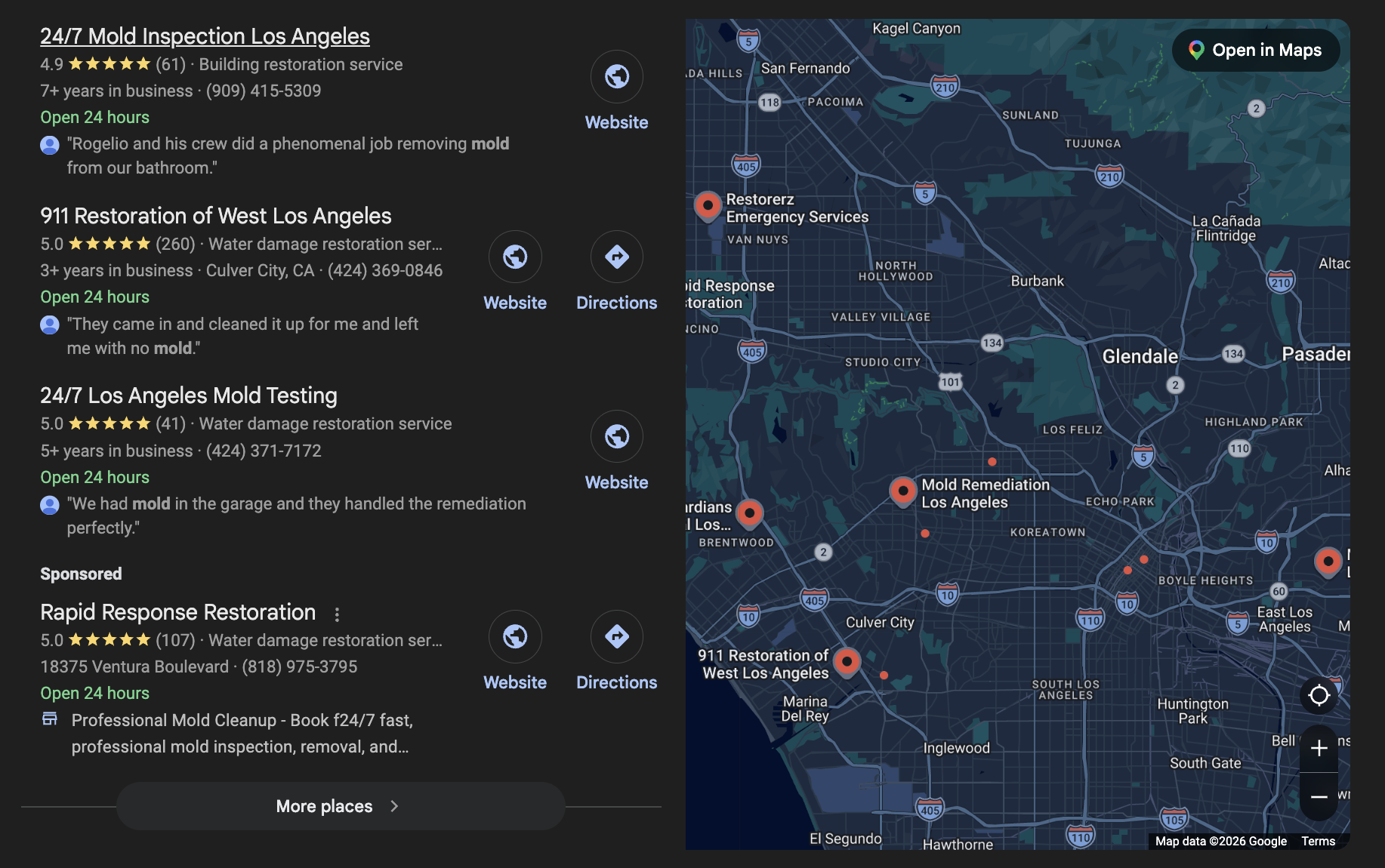
Your Google Business Profile (GBP) drives the majority of emergency calls.
Ranking in the map pack often matters more than organic rankings.
Key factors:
- Consistent NAP (name, address, phone)
- Reviews and response rate
- Service categories and descriptions
Deep optimization through Google Business Profile optimization can dramatically increase call volume.
Content Strategy for Consistent Leads
Content is how you scale SEO.
Instead of one page, you build a network of pages targeting related keywords.
Example structure:
- Main SEO page (this page)
- Service-specific SEO pages
- Lead generation guides
This supports your broader restoration lead generation system.
Turning Traffic Into Calls and Jobs
Traffic alone does not generate revenue.
You need:
- Clear CTAs
- Fast-loading pages
- Mobile optimization
- Call tracking
This is where conversion optimization for restoration companies becomes critical.
Implementation Plan
To execute this strategy:
- Build core SEO pages
- Optimize GBP listing
- Create supporting content
- Track calls and conversions
Consistency is what creates momentum.


Pingback: Restoration Marketing: The 3 Channels That Actually Generate Jobs - Damage Restoration Hero