SEO for Restoration Companies
SEO for restoration companies is the process of increasing your visibility on Google so that your business appears when homeowners and property managers search for emergency services. Whether it’s water damage, fire cleanup, or mold remediation, the companies that rank first are the ones that consistently get the calls.
Unlike paid ads, SEO compounds over time. When executed correctly, it becomes your most reliable source of inbound jobs.
Table of Contents
What Is SEO for Restoration Companies?
Why Most Restoration Companies Fail at SEO
How Google Ranks Restoration Companies
Keyword Strategy That Drives Calls
On-Page SEO That Converts
Google Business Profile and Map Pack Rankings
Content Strategy for Consistent Leads
Turning Traffic Into Jobs
Implementation Plan
What Is SEO for Restoration Companies?
SEO for restoration companies focuses on ranking your business for high-intent searches like “water damage near me,” “fire damage cleanup,” and “mold remediation services.” These are not casual searches—they are urgent situations where the first visible company often wins the job.
A strong damage restoration SEO strategy ensures your business shows up at the exact moment someone needs help.
Why Most Restoration Companies Fail at SEO
Most restoration companies fail at SEO because they treat it like a one-time task instead of an ongoing system. Common mistakes include:
- Thin service pages with little content
- No internal linking strategy
- Ignoring local SEO and map rankings
- Focusing on traffic instead of conversions
Without a structured approach, even well-designed websites struggle to generate consistent jobs.
How Google Ranks Restoration Companies
Google ranks restoration companies based on three core factors:
- Relevance: How well your content matches search intent
- Authority: The strength of your website and backlinks
- Proximity: How close your business is to the searcher
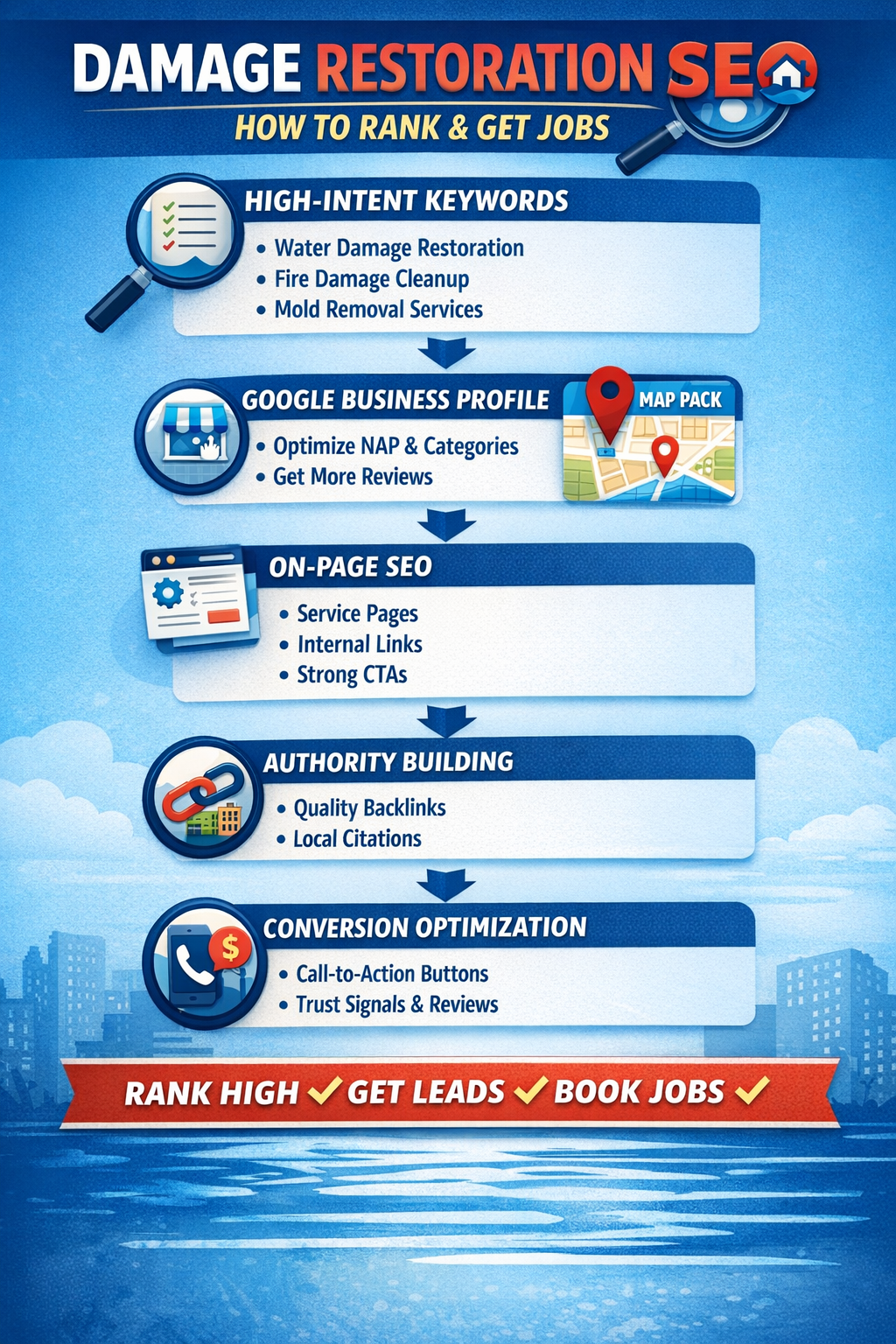
Damage restoration SEO is not one tactic – it’s a system. Companies that align keywords, Google Business Profile, on-page SEO, authority building, and conversion optimization consistently dominate rankings and inbound job flow.
Each layer in this system works together to generate consistent visibility and inbound calls. A properly structured damage restoration SEO strategy ensures your business ranks across multiple high-intent searches while reinforcing authority across your entire site.
When combined with a strong restoration lead generation system and focused efforts to capture water damage leads, this framework becomes a predictable engine for driving new jobs without relying on paid ads.
Companies that align all three dominate both organic rankings and the Map Pack.
Keyword Strategy That Drives Calls
Not all keywords are equal. Restoration SEO works best when you focus on high-intent searches:
- Water damage restoration
- Fire damage cleanup
- Mold removal services
- Emergency restoration near me
These searches indicate immediate need, making them far more valuable than general informational traffic.
Capturing these searches consistently is directly tied to how well you structure your restoration lead generation system.
On-Page SEO That Converts
On-page SEO ensures your pages not only rank but also convert visitors into calls. This includes:
- Clear service-focused headlines
- Fast-loading pages
- Strong internal linking
- Call-to-action placement throughout the page
When done correctly, your website becomes both a ranking asset and a conversion engine.
Google Business Profile and Map Pack Rankings
The majority of restoration calls come from the Map Pack. Optimizing your Google Business Profile is essential for capturing local demand.
This includes:
- Accurate business information (NAP)
- Service categories
- Regular updates and posts
- Consistent reviews
Content Strategy for Consistent Leads
Content is what builds long-term authority. Instead of publishing random blog posts, you need structured topic clusters that support your main services.
For example, a water damage cluster should include supporting content that helps capture water damage leads from multiple entry points.
This creates a system where multiple pages feed into your core services.
Turning Traffic Into Jobs
Traffic alone does not generate revenue. Conversion is what turns visibility into booked jobs.
This includes:
- Click-to-call buttons
- Clear service messaging
- Trust signals and certifications
- Fast response positioning
Strong conversion optimization for restoration companies ensures that more visitors become paying customers.
Implementation Plan
To implement an effective SEO strategy, follow these steps:
- Build high-quality service pages
- Create supporting content clusters
- Optimize your Google Business Profile
- Implement strong internal linking
- Focus on conversion optimization
When these elements work together, SEO becomes a predictable system for generating consistent restoration jobs.